Vision correction options for running-related sports
I enjoy both running, and the sport of orienteering – which involves using a map and compass to navigate between a series of set checkpoints as fast as possible (see https://www.britishorienteering.org.uk/). Something I’d noticed for both of these sports is the wide range of vision corrections people use, which I wanted to explore further to see what insights could be gleaned that would be useful to optometrists and dispensing opticians. Both research papers have now been published and are open access (Latham et al., 2024; Latham et al, 2025), but some of the key points are:
- Spectacles don’t present a barrier to engaging in running-related sports, but key problems experienced with them are lenses getting rained on or fogging up, concerns about damage, and the view of the ground being affected with multifocal lenses.
- Contact lenses are more commonly used by younger and female runners, so proactively signpost older and male runners to contact lenses as they may not have considered these as a solution. Presbyopic runners with near vision needs (such as orienteers) should be made aware of up-to-date multifocal contact lens options.
- A quarter of runners sometimes run without a correction, and while this may reflect that vision is not considered sufficiently impaired without correction to make wearing one worthwhile, it can also reflect that they do not have a suitable correction to wear for running.
- 57% of the orienteers had purchased a vision correction specifically for the sport, indicating some level of willingness to buy appliances for particular tasks.
- People valued a personalised discussion of their visual needs, with the ability to explain their needs to practitioners who are willing to be curious about understanding and solving these needs.

An infographic for orienteers to share with their eyecare practitioners to prompt discussion of their visual needs in the sport.
Inaugural lecture slides
The slides for my lecture on April 19th 2023 are available here:
These are accessible for those with visual difficulty, and include clickable links to the resources (references and support for people with vision loss) mentioned. They don’t include the personal photos used in the talk!
Inaugural Professorial lecture
I’m delighted to announce my inaugural Professorial lecture “You can’t be what you can’t see?” – a free public lecture (in person only) at Anglia Ruskin University (ARU) in Cambridge on April 19th 2023. I’ll be talking about sight loss, with aspects of general interest, to people with sight loss, and to clinicians (1 interactive CPD point!). I’ll also give my perspective on academic / clinical career progression as a female Professor in STEM. All are very welcome – tickets are available through the link below:
Professor Latham!
As of August 1st 2022, I’m now Professor of Optometry at ARU. I’m really proud to have reached this milestone in my academic career. It certainly wouldn’t have been possible without the support of many colleagues, collaborators, mentors, family members and friends.
My inaugural Professorial lecture is provisionally booked for April 2023, and I look forward to sharing more details nearer the time.
College Council (elect)
I’d really like to thank all College of Optometrists members in the Eastern region who voted for me in the recent College Council elections. I’ve been elected to one of the three open posts, along with David Hill and John Kidd, and we will take up our posts in March.
It’s a time of huge change in the profession, not least with the impact that COVID is having and that the GOC’s educational strategic review is likely to have. I look forward to doing my part in moving the profession forward in the face of these and other challenges.

Should it be of interest, below is the full election manifesto on which I stood:
What is your motivation for standing for Council ? What do you seek to do/take forward on behalf of members and the profession?
The optometric profession faces fundamental change. The Covid pandemic and the GOC’s Educational Strategic Review will change the profession at every level, from education to service delivery. The College has the opportunity to be at the forefront of leading this change in directions of value to the profession and to the public, and I want to be able to represent the views of Eastern region members in developing these changes. Key areas include:
- Greater emphasis on upskilling through structured career progression and increased post-graduate specialisation opportunities, such as through College higher qualifications.
- Undergraduate education must continue to provide deep theoretical knowledge across a full range of clinical practice to produce clinicians (not technicians) adaptable to future change.
- Optometry must maintain its reputation as a research-led, evidence-based profession through continued support for optometric research.
- The profession must take a harder look at embedding equality and diversity in all its activities.
Tell us about yourself and your professional background
I am an Associate Professor at Anglia Ruskin University (ARU).
I graduated from Aston University in 1990. Following a pre-registration year in independent practice in Northumberland I returned to Aston, completing a PhD in 1995, and was a lecturer there until 2000. While my children were small, I worked part-time in multiple practices in Norfolk and Nottinghamshire, and in 2006 I joined ARU. Throughout my time at ARU I have worked regularly in independent practice in Huntingdon, including involvement in glaucoma shared care schemes, and direct referral cataract pathway.
My key interests are in low vision, visual function assessment, and dispensing. I am Associate Editor of the journal ‘Ophthalmic and Physiological Optics’. As ARU representative on Optometry Schools Council, I have broad knowledge of the issues facing optometry education. Having led the submission for our Faculty Athena SWAN award, a gender equality chartermark, I also have understanding of equality issues.
What do you feel you can bring to the Council and the College?
I am unconvinced by many of the changes inherent in the ESR, and am happy to engage with Eastern members on how they want the College to respond to the proposals to provide a strong representation from the wider profession. From my career to date I can offer educational, research, and clinical expertise and experience from university and primary care settings, including knowledge of the ESR.
I have been a College member since qualification, and involved with the College throughout my career. I have been a pre-registration supervisor and examiner, undertaken higher qualifications (FCOptom, Prof Cert LV), and supervised 3 successful College PhD students. In 2017 I received the Neil Charman medal for excellence in research.
I want to give back something to the profession that has offered me so many opportunities, and to help to drive strategic change in the profession on behalf of Eastern region members.
The 2017 Neil Charman Medal
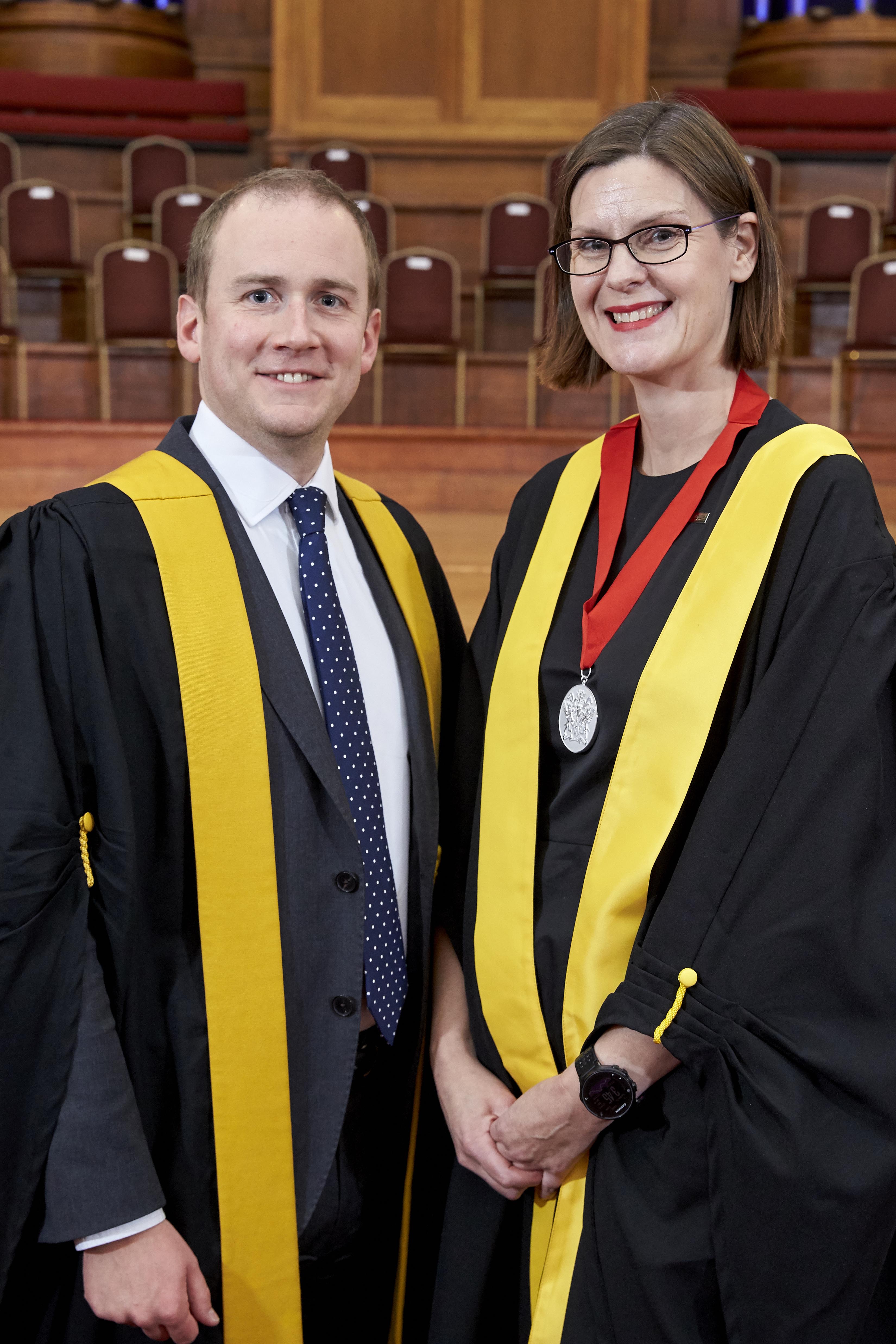
At the end of last year, I was absolutely delighted to be presented with the Neil Charman Medal for excellence in optometric research by Prof Leon Davies on behalf of the College of Optometrists at their annual graduation ceremony in Central Hall, Westminster.
To receive such an award from my own professional body is a real honour. I am very grateful to the College for their recognition, and hope that my research is, and continues to be, useful to people with vision loss.
Visual impairment and activity
In a paper we have recently published we show that in a large cohort epidemiological study, older people who self-rate their eyesight as ‘poor’ or ‘fair’ were twice as likely to be inactive (undertaking moderate physical activity less than once a week) than people rating their eyesight as ‘excellent’. The data presents an association rather than cause and effect. However, there is the potential for lack of physical activity to lead to an increased likelihood of health problems that can cause poor eyesight, such as diabetes. Equally, it can be more difficult for people with poor vision to exercise and be active. In another recent study we showed that ‘physical activity and / or sport’ was the third most challenging activity of daily living for people with the eye condition Retinitis Pigmentosa. Finding ways to help people with poor vision exercise safely therefore has the potential to be extremely valuable. For those with poor vision, I would highly recommend British Blind Sport, for information on a range of different sports. The RNIB website also has a good overview of available resources. One organisation particularly close to my heart is parkrun, who organise free weekly 5k runs around the country (and the world). They are undertaking a project to provide guide runners to people with visual impairment to enable them to take part. I would be more than happy to volunteer as a guide for anyone in the Cambridge area, bearing in mind that as I don’t run very fast I would be much more suited to guiding a beginner!
Position available
Prof Peter Allen and myself are currently recruiting a postdoctoral research fellow to work on an exciting project relating to vision and sport. We are looking for someone with a PhD in either vision or sport related areas, and further details of the position and how to apply are on the Anglia Ruskin University website. As background information, some of our preliminary work in this area might be of interest.
Proud to be a ‘Rasch nerd’
A couple of weeks ago I took part in the 10th annual Rasch User conference in my childhood stomping ground of Durham. It was an extremely interesting day and even involved a fantastic interval-scale cake! My presentation was on the use of Rasch analysis in understanding rehabilitation needs in low vision, the slides for which are now available.
Eye health at risk?
The Royal College of Ophthalmologists has suggested that increasing demand on hospital eye care services from long term conditions is putting peoples’ sight at risk. The College of Optometrists has noted that one way to try to reduce pressure on services is provision of community based services. In an interview about the situation local to Cambridge, I’ve tried to highlight how some of our current local community schemes (direct cataract referral, glaucoma referral refinement, monitoring of ocular hypertensives and minor eye conditions pathway) are helping to ease the pressure, whilst we can still do more in terms of community based low vision service provision.


Recent Comments